“The most common engineering problem in Indian manufacturing is not a new design challenge — it is a part that needs to be reproduced or replaced when the original drawings no longer exist.”
Reverse engineering in manufacturing is the process of analysing an existing physical component, assembly, or product to extract its geometric, material, and functional specifications — and then creating the CAD models, technical drawings, and documentation needed to reproduce or improve it. It is one of the most practically important capabilities in engineering design services, and one of the most consistently underestimated.
The need for reverse engineering arises in several common situations: a critical production component has failed and the original supplier is no longer available. A machine that has been running for twenty years needs a replacement part for which no drawing exists. A product acquired through import substitution comes without design documentation. A company wants to improve or create a compatible alternative to an existing component. In each of these situations, the physical part is the starting point — and reverse engineering is the process that converts it into usable engineering data.
What Reverse Engineering in Manufacturing Actually Involves
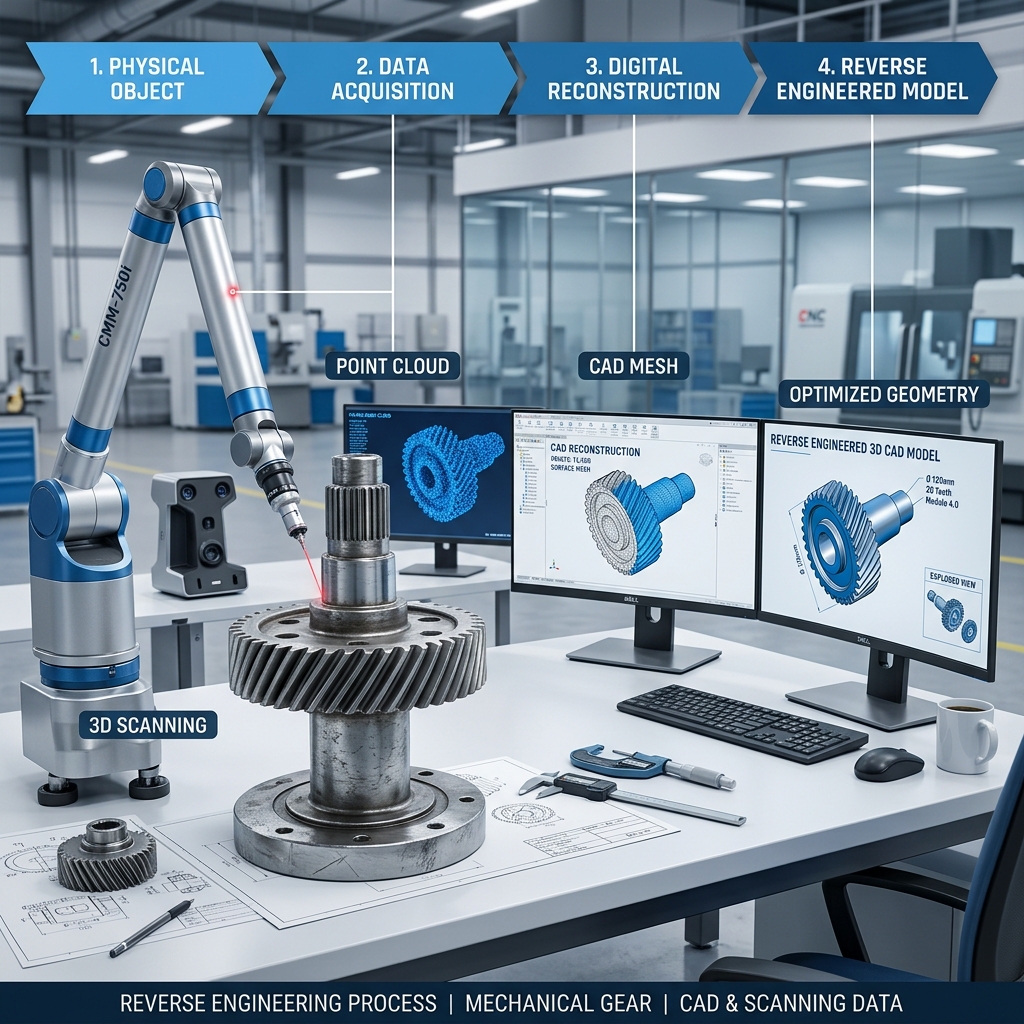
Reverse engineering is not simply scanning a part and converting the scan to a CAD file. That process produces a digital copy of a physical object, which may contain manufacturing variation, wear, damage, and surface artifacts that should not be reproduced in the replacement design. Professional reverse engineering involves: physical measurement and data capture to record geometry to the accuracy required for the part's function; analysis and interpretation to understand which features are functionally critical and which dimensions reflect variation or wear to be corrected; CAD model construction building a parametric, editable model that captures design intent rather than as-measured geometry; and documentation producing technical drawings with appropriate tolerances, material specifications, and surface finish requirements.
Where Reverse Engineering Adds the Most Value in Manufacturing
Legacy Part Reproduction for Maintenance and Spares
Manufacturing facilities across India operate machines purchased decades ago — sometimes from suppliers who no longer exist, almost always without adequate spare parts inventory. When a critical component fails and no replacement is available through conventional supply chains, reverse engineering is the solution. A production line that would otherwise be down for weeks while a replacement is sourced internationally can be restarted within days once a local supplier produces a reverse-engineered replacement. The cost of reverse engineering is a fraction of the cost of extended production downtime.
Import Substitution and Localisation
A major driver of reverse engineering activity in Indian manufacturing is import substitution — replacing imported components with locally manufactured equivalents. Government policy incentives, supply chain resilience concerns, and cost reduction pressures all drive demand for domestic alternatives to imported parts. Reverse engineering provides the design data that local manufacturers need to produce these alternatives to the required specification, including material properties, heat treatment conditions, surface treatment requirements, and functional performance specifications.
Product Improvement and Value Engineering
Reverse engineering is not only used to reproduce existing products unchanged. It is frequently used as the starting point for improvement — understanding how an existing product works in order to make it work better. A component identified as a field failure point can be reverse engineered to understand its design margins, then redesigned with additional strength, reduced weight, or improved manufacturing efficiency. Value engineering through reverse engineering identifies where material can be removed, where manufacturing steps can be eliminated, or where a simpler alternative design achieves the same function at lower cost.
Competitive Analysis and Compatible Design
Understanding how a competitor's product is designed — its geometry, assembly logic, material choices, and manufacturing approach — is a legitimate engineering activity that informs competitive product development. Reverse engineering for competitive analysis provides design teams with concrete data about how existing market solutions address engineering problems, enabling more informed design decisions for new product development.
ReneChip's reverse engineering services cover physical measurement and data capture, parametric CAD model construction, technical drawing production, and material and process specification — delivering complete, manufacturing-ready design data from physical parts.
The Technology Behind Modern Reverse Engineering
3D Scanning and Point Cloud Processing
3D scanning captures the surface geometry of a physical part as a dense cloud of measured points. Structured light scanners, laser scanners, and CT scanning each have different accuracy levels and suitability for different part types. Point cloud data is processed to create mesh representations of the part surface, used as reference geometry for CAD model construction. A skilled reverse engineer uses scan data as a dimensional reference while constructing a parametric CAD model that reflects how the part should be designed — with clean geometry and appropriate feature relationships — rather than simply wrapping the scan data in a CAD shell.
CMM Measurement for Critical Features
For components with tight tolerances and critical functional dimensions — bearing seats, mating surfaces, thread specifications — coordinate measuring machine (CMM) measurement provides accuracy that 3D scanning cannot match. CMM measurement identifies the nominal dimensions and the actual variation present in the physical sample, allowing the reverse engineer to distinguish design intent from manufacturing variation.
How ReneChip Delivers Reverse Engineering Services
ReneChip's engineering design team provides reverse engineering services for manufacturing clients across industrial, automotive, and mechanical engineering sectors. We work from physical samples, scan data, or partial drawing information to produce complete, parametric CAD models and technical drawings suitable for local or international manufacturing. Our reverse engineering projects typically deliver: a fully parametric CAD model in the client's preferred format, 2D technical drawings with GD&T and tolerance specifications, a material and process recommendation report, and where requested, a manufacturing feasibility assessment.
Frequently Asked Questions — Reverse Engineering in Manufacturing
Q: Is reverse engineering of a competitor's product legal?
Reverse engineering for understanding design, creating compatible components, or developing improved alternatives is generally legal in India and most jurisdictions, provided it does not involve breach of trade secret agreements or patent infringement. ReneChip recommends clients obtain their own legal advice on specific situations involving competitive products.
Q: What level of accuracy can ReneChip achieve in reverse engineering?
For precision components, CMM measurement achieves accuracies in the range of ±0.01mm. 3D scanning accuracy ranges from ±0.02mm to ±0.1mm depending on scanner type and part size. We recommend the measurement approach based on the functional requirements of the specific component being reverse engineered.
Q: Can ReneChip reverse engineer complete assemblies, not just individual parts?
Yes. ReneChip handles reverse engineering of complete assemblies — capturing individual component geometry and reconstructing assembly relationships, clearances, and fit specifications. Assembly reverse engineering is scoped based on the number and complexity of components involved.
Q: How long does a reverse engineering project typically take?
A straightforward single component can be delivered in two to five business days. Complex assemblies with multiple components and full documentation typically require two to four weeks. Contact info@renechip.com with your specific requirement for an accurate timeline estimate.
Q: What information does ReneChip need to start a reverse engineering project?
We need access to the physical part or assembly, information about its function and performance requirements, manufacturing process and material constraints for reproduction, and any partial drawings or documentation that exists.