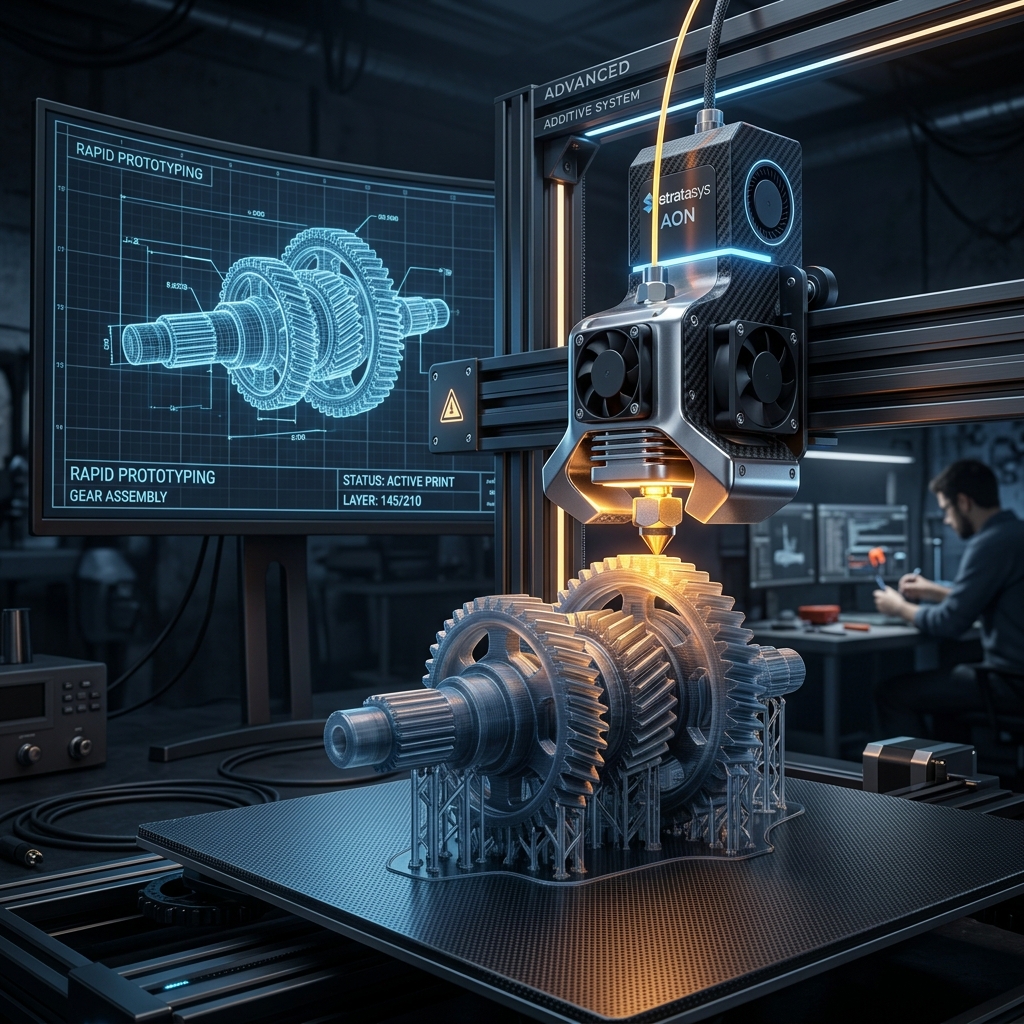
“The fastest way to discover that a design has a problem is to hold the design in your hands. Rapid prototyping makes this possible weeks before conventional manufacturing would have produced the first part.”
Product development has always involved a fundamental tension: the need to validate that a design works before committing to the cost of full-scale manufacturing. Historically, this validation required producing physical prototypes through conventional manufacturing processes — machining, casting, fabrication — that were slow, expensive, and constrained by production tooling lead times. A design iteration that today takes hours to model and a day to print once required weeks of manufacturing lead time and significant cost.
Rapid prototyping with 3D CAD has transformed this dynamic. The combination of parametric CAD modelling and additive manufacturing technologies allows design teams to move from a digital model to a physical part in hours or days — enabling faster design validation, more design iterations within the same development timeline, and physical testing of concepts that would previously have been evaluated only in simulation.
What is Rapid Prototyping with 3D CAD — The Process Explained
Rapid prototyping refers to the fast production of physical parts or assemblies from digital design data — specifically from 3D CAD models. The term encompasses a range of additive manufacturing technologies, each with different material capabilities, accuracy levels, surface finish quality, and cost profiles. The common factor is that parts are built by adding material layer by layer from a digital model, without the tooling setup required by conventional manufacturing. The workflow begins with a 3D CAD model exported in STL or STEP format, processed by slicing software that divides the model into thin horizontal layers and generates machine instructions. The physical part is then built layer by layer according to these instructions.
Key Rapid Prototyping Technologies and Their Engineering Applications
FDM — Fused Deposition Modelling
FDM is the most widely available additive manufacturing technology. A thermoplastic filament is melted and deposited through a precision nozzle to build the part layer by layer. FDM is well-suited to concept models, functional housings, brackets, and parts where dimensional accuracy requirements are moderate. Industrial FDM systems achieve dimensional tolerances in the range of ±0.2mm and can produce parts in engineering-grade materials including Nylon and Polycarbonate with useful mechanical properties.
SLA — Stereolithography
SLA uses an ultraviolet laser to cure a photosensitive resin layer by layer, producing parts with significantly finer detail and smoother surface finish than FDM. SLA is appropriate for prototype parts used for fit and appearance evaluation, for small components with fine features, and for master patterns used in silicone moulding. Surface finish quality from SLA is close to injection-moulded plastic, making it suitable for customer presentation models and design review samples.
SLS — Selective Laser Sintering
SLS uses a high-power laser to fuse powdered polymer layer by layer, producing parts without support structures because the surrounding powder supports the part during building. SLS produces mechanically functional parts with good strength and complex geometry that FDM and SLA cannot easily achieve. It is commonly used for functional prototype assemblies, living hinges, snap-fit components, and parts that will undergo mechanical testing.
Metal Additive Manufacturing
DMLS and SLM technologies produce metal parts directly from 3D CAD data — in stainless steel, titanium, aluminium, and other engineering alloys. Metal additive manufacturing is used for aerospace brackets, medical implants, heat exchangers, and components where complex geometry provides functional advantages that cannot be achieved through conventional machining. Material properties approach those of machined equivalents when process parameters are correctly optimised.
ReneChip's 3D CAD and product development services prepare design files for rapid prototyping — ensuring models are optimised for the specific prototyping technology being used, with correct wall thicknesses, feature sizes, and orientation strategies for the chosen process.
Where Rapid Prototyping with 3D CAD Adds Most Value in Product Development
Early Concept Validation
The first physical model of a design concept reveals things that no amount of digital visualisation fully discloses: how the product feels in the hand, whether components align when physically assembled, and where interference issues exist that were not apparent in the CAD model. Producing concept models in the first weeks of design development — before significant engineering time has been invested in a specific direction — saves time and cost by identifying fundamental issues early.
Fit and Function Testing Before Tooling
For components that will ultimately be injection-moulded or die-cast, rapid prototyping allows functional testing before tooling is committed. A prototype housing assembled with production electronics, a prototype bracket installed on a production machine, a prototype seal tested under operational conditions — each validation step reduces the risk that the first production tool will require expensive modification. The cost of a prototype is orders of magnitude less than the cost of a tooling change.
Design Iteration at Speed
The ability to revise a CAD model and have a new prototype the next day transforms the design iteration process. Design teams can explore multiple alternatives rapidly, test each physically, and make evidence-based decisions about which direction to pursue. This speed of iteration is particularly valuable in competitive product development where time-to-market is a differentiator.
What Design Engineers Need to Know for Effective Rapid Prototyping
Designing for rapid prototyping requires understanding the capabilities and constraints of the prototyping technology being used: minimum wall thicknesses, overhang angles requiring support structures, feature sizes achievable at the target layer resolution, and material properties that differ from the intended production material. A prototype produced with understanding of these constraints — designed for the prototyping technology while representing the production design intent — provides genuine validation value. ReneChip's engineering design team applies this understanding when preparing 3D CAD models for prototyping applications.
Frequently Asked Questions — Rapid Prototyping with 3D CAD
Q: What file format does 3D CAD need to be exported in for rapid prototyping?
STL is the most universally accepted format for additive manufacturing systems. STEP format is increasingly supported by advanced prototyping software and retains more geometric information than STL. ReneChip prepares and exports models in the format required by the client's prototyping partner.
Q: How accurate are rapid prototypes compared to production parts?
FDM typically achieves ±0.2mm to ±0.5mm, SLA and SLS achieve ±0.1mm to ±0.2mm, and metal additive systems achieve ±0.05mm to ±0.1mm before post-processing. For tight-tolerance features, post-machining of prototype parts is commonly used to achieve production-equivalent accuracy.
Q: Can rapid prototypes be used for functional testing, or only for appearance evaluation?
Both, depending on the technology and material. SLS Nylon parts can be used for mechanical function testing including snap-fits, hinges, and structural loading. Metal additive parts approach production material properties and can be used for pressure testing and thermal cycling. FDM and SLA parts are generally used for fit and appearance evaluation.
Q: Does ReneChip provide 3D CAD preparation services for rapid prototyping?
Yes. ReneChip prepares and optimises 3D CAD models for rapid prototyping — checking wall thicknesses, adding draft where appropriate, orienting models for optimal build quality, and exporting in the required format. Contact info@renechip.com to discuss your prototyping design requirement.