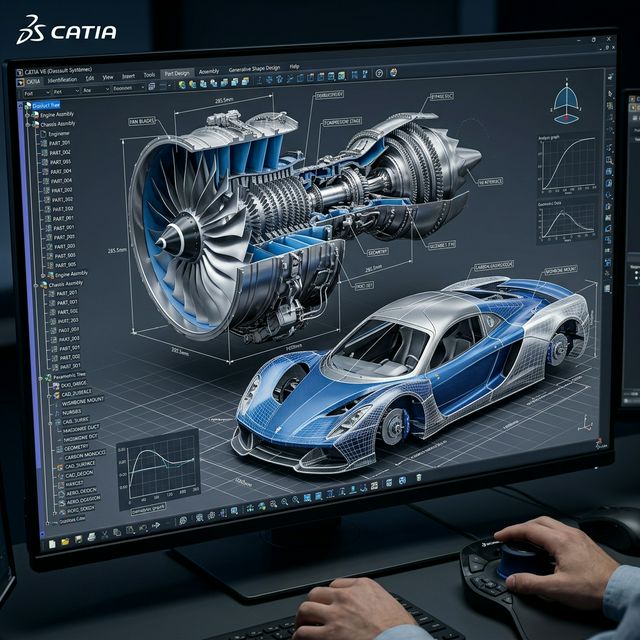
When Boeing, Airbus, Toyota, and BMW all choose the same platform to design their most complex products, there is a reason. CATIA is not just a CAD tool — it is the language of precision engineering at the highest level.
There are dozens of CAD platforms available today. Engineers argue endlessly about SolidWorks vs. CREO vs. NX. But at the very top end — where tolerances are measured in microns, assemblies have ten thousand components, and a single error can cost lives — one platform consistently dominates: CATIA.
Developed by Dassault Systemes, CATIA (Computer-Aided Three-dimensional Interactive Application) has evolved into the world's most sophisticated 3D CAD, CAM, and CAE platform. For companies that build the most complex manufactured objects in the world, it remains the non-negotiable standard.
Real-World Proof: The Airbus A380 — comprising over 4 million components — was designed entirely within CATIA's digital product lifecycle environment, enabling teams across multiple countries to co-develop without a single physical prototype until the final stages.
What Makes CATIA Different from Other CAD Platforms
Most mid-market CAD tools are built around solid modeling — you define shapes through extrusions, cuts, and features. CATIA, by contrast, is a complete Product Lifecycle Management (PLM) ecosystem. That is a fundamental difference:
- Generative Shape Design (GSD) — Class A surface modeling with G2/G3 continuity for aerodynamic and aesthetic surfaces.
- Assembly Design with DMU — Digital Mock-Up functionality enabling interference detection and kinematics simulation.
- Structural FEA Integration — Direct finite element analysis within the same environment, eliminating file translation errors.
- Knowledge-Based Engineering (KBE) — Design rules and checks embedded directly into the model.
- Sheet Metal and Composites Workbenches — Specialized modules for materials and processes.
CATIA in Aerospace: Where Precision Is Life-Critical
In aerospace design, the margin for error is effectively zero. A turbine blade operating at 1,500 degrees C with a wall thickness of 1.2mm and a surface profile tolerance of +/-0.05mm cannot be designed in a tool that approximates surfaces. CATIA's exact B-Rep geometry kernel ensures what you model is what you manufacture.
ReneChip's CATIA-certified engineers bring deep experience in aerospace-specific workbenches — from airframe structural analysis to nacelle surface modeling to hydraulics routing — making us a trusted partner for Tier 1 and Tier 2 aerospace suppliers.
CATIA in Automotive: From Clay Model to Production
Automotive design is a unique challenge: Class A exterior surfaces must be aerodynamically efficient, aesthetically refined, and manufacturable as stamped steel panels — all at once. CATIA's Automotive BiW (Body-in-White) module handles this complexity natively, letting designers, aerodynamicists, and manufacturing engineers work in the same data environment simultaneously.
Work With CATIA-Certified Engineers Who Deliver Results
ReneChip provides pre-screened CATIA V5/V6 engineers for aerospace, automotive, and industrial design — available on flexible remote contracts.
Hire a CATIA Engineer Explore ServicesCATIA V5 vs V6 (3DEXPERIENCE): Which Should Your Team Use?
The short answer: CATIA V5 for legacy and supplier compatibility; V6/3DEXPERIENCE for new programs needing cloud collaboration and PLM integration. Most manufacturers today run both — V5 for existing product support, V6 for new development.
- CATIA V5 — Mature, stable, widely adopted. Enormous ecosystem of templates and macros built over decades.
- CATIA V6 / 3DEXPERIENCE — Cloud-native PLM backbone. Real-time collaboration. No file management chaos.
Not Sure Which CATIA Setup Is Right for Your Project?
Our engineers help clients evaluate, configure, and ramp up on CATIA workflows tailored to their industry and project needs.
Get Expert Guidance Download Brochure