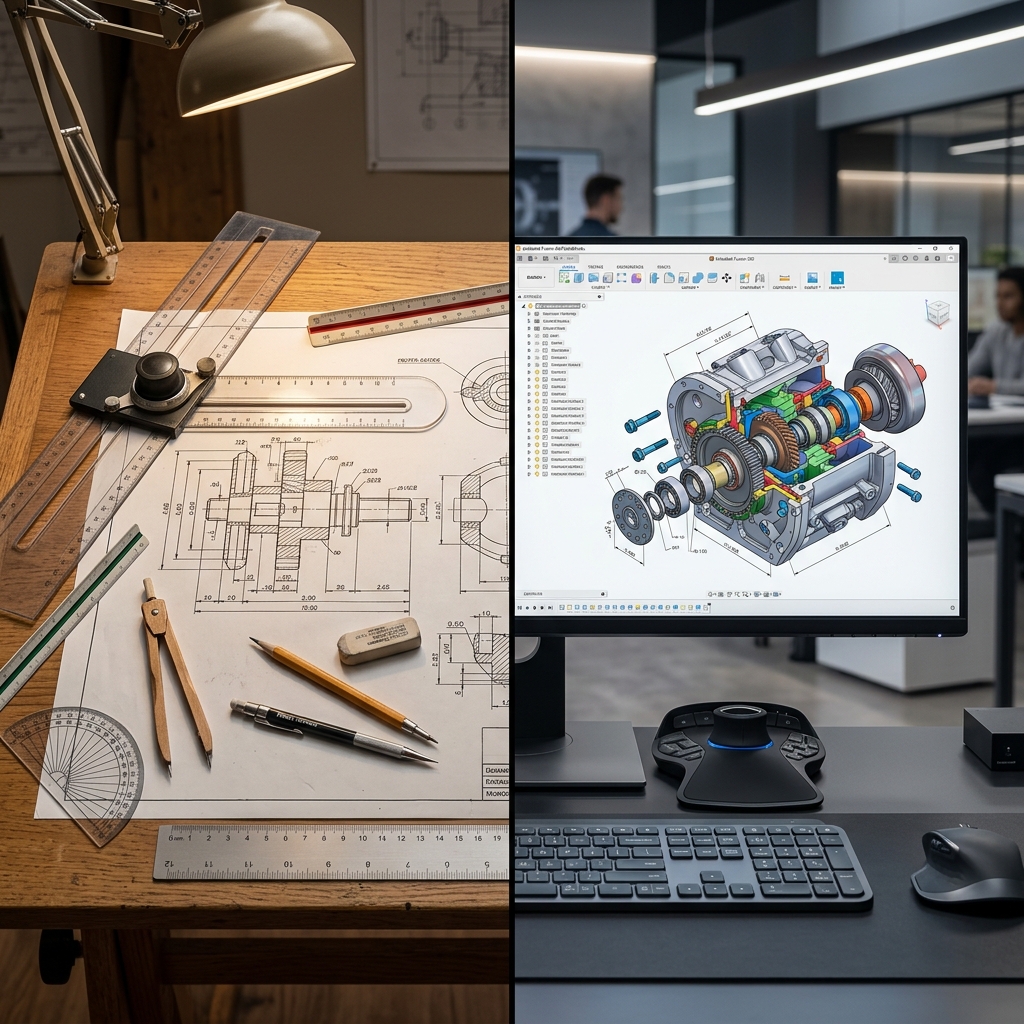
CAD Drafting vs Manual Drafting — Why Precision Manufacturers Must Make the Switch
"Precision is not an option in modern manufacturing — it is the barrier between a successful production run and thousands of dollars in scrapped material. Digital CAD drafting ensures that precision starts at the design phase."
For over a century, the drafting board was the heartbeat of engineering. Teams of draftsmen leaned over massive tables, using T-squares, compasses, and drafting pens to meticulously ink the blueprints of locomotives, aircraft, and bridges. But today, the demands of global supply chains and precision manufacturing have outpaced what manual drawings can support. The switch from manual drafting to Computer-Aided Design (CAD) is no longer a technological luxury; it is a critical necessity for survival.
In this blog, we compare CAD drafting with manual drafting across precision, revision management, downstream automation, and business efficiency. We also examine why making the digital switch is vital for precision manufacturers and how they can digitize their legacy drawing archives without disrupting operations.
The Precision Divide: Digital Models vs. Paper Blueprints
The most fundamental difference between manual and CAD drafting lies in mathematical accuracy. A physical line drawn on paper is limited by the thickness of the pencil lead, the texture of the paper, and the steady hand of the draftsman. Scaling a drawing manually introduces rounding errors, and measuring dimensions directly from a print can result in discrepancies that lead to component interference on the shop floor.
CAD software operates in a mathematically infinite digital coordinate space. A model is defined by coordinate geometries down to the sub-micron level, ensuring that tolerances are absolute. A geometric tolerance of ±0.001 mm is simulated perfectly in a 3D CAD environment. When these designs are sent to high-precision CNC machines or electrical discharge machining (EDM) centers, this digital precision translates directly into physical accuracy, eliminating manufacturing reworks due to drafting errors.
Revision Management and Collaborative Workflows
In engineering, design is an iterative process. With manual drafting, a minor change to a complex part — such as modifying the radius of a pocket or shifting the center of a bolt pattern — often required scraping the original drawing and manually redrawing entire views. This process took days, delayed production schedules, and increased overhead. Furthermore, ensuring that physical drawings were updated across all manufacturing teams was a logistical nightmare.
CAD software simplifies revision management with database systems and digital markups. Parametric features allow a designer to change a single dimension and have the entire model, assembly, and associative 2D drawing sheets update automatically. Digital versioning ensures that every team member, supplier, and machinist is working from the latest revision level, preventing the manufacture of obsolete components.
Why CAD is Crucial for Modern Downstream Manufacturing
A technical drawing is no longer just a visual representation for a human machinist. Today, the CAD model is the starting point for a fully integrated manufacturing pipeline:
- Direct CAM Integration: CAD geometry feeds directly into Computer-Aided Manufacturing (CAM) software to generate G-code toolpaths for CNC machines, bypassing manual transcription.
- Finite Element Analysis (FEA): Digital models can be subjected to virtual stress tests, thermal analyses, and aerodynamic simulations before any material is cut.
- Rapid Prototyping: CAD files can be exported directly to 3D printers and rapid tooling systems for physical validation within hours.
- Digital Twins: A virtual 3D assembly acts as a digital twin for asset tracking, assembly sequencing, and maintenance modeling.
The Business Impact: Speed, Cost, and IP Protection
From a business perspective, the transition to CAD delivers a massive return on investment. Design cycles that once took months are completed in weeks. The ability to reuse existing CAD components, import standard hardware libraries, and copy-paste design features speeds up time-to-market. Furthermore, physical drawings are vulnerable to fire, water damage, and physical wear, whereas digital CAD files are backed up on secure cloud servers, protecting the company's intellectual property indefinitely.
For manufacturers holding archives of hand-drawn blueprints, professional CAD conversion services can modernize these drawings. Transitioning legacy manual data to native CAD files preserves the intelligence of the original designs while unlocking the benefits of modern manufacturing technology.
Need Professional CAD Drafting, 2D to 3D Conversion, or Legacy Drawing Digitization?
ReneChip provides precision CAD drafting, technical drawing conversion, and legacy blueprint digitization services to ensure your designs meet modern manufacturing standards.
renechip.com
info@renechip.com
+91 9842160709
ReneChip — 97G/4C/1, 1st Floor, PSS Jayam Towers, Teachers Colony, Tuticorin, Tamil Nadu 628008